The commercial shift behind our growth
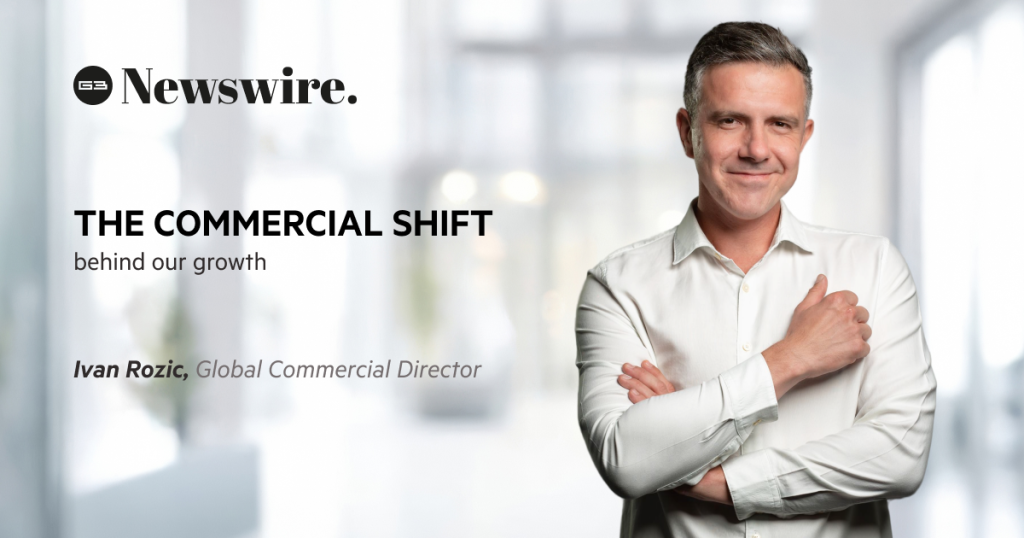
Showcasing the partners who built the success of the company’s turnkey technology, Ivan Rozić, Global Commercial Director, underlines the importance of actively listening to operator pain points rather than rigid product selling to secure and maintain long-term partnerships with tier one operators.
As EveryMatrix arrives at ICE with a “proof over promises” message, Ivan Rozić is clear this isn’t a new positioning – it’s simply the first time the company has so much evidence to back it up.
“We’ve never had more proof than we do today,” Ivan explains. After years of sustained delivery, he believes the results now speak louder than any product pitch ever could. In an industry crowded with technology providers, distinguishing what genuinely works from what merely sounds good has become increasingly difficult for operators. “I fully understand how demanding that is on operators. That’s why references matter.”
For Ivan, trust is rarely built in the sales meeting itself. Decisions are shaped elsewhere, through peer conversations and lived experience. “Potential partners always talk to others you’re already working with,” Ivan underlines. “You need people to vouch for you.” As he puts it with a smile, “a guy and a donkey are smarter than just a guy.”
That emphasis on credibility is closely tied to EveryMatrix’s commercial model. Ivan is candid about his discomfort with traditional labels like “clients” or “customers,” arguing they don’t capture the nature of the relationship the company is trying to build. “Around 93 per cent of our revenues come from revenue share. If our partners grow, we grow.”
This alignment of incentives has shaped how EveryMatrix approaches sales. Rather than pushing rigid product packages, Ivan describes a consultative, turnkey platform-led mindset focused on long-term outcomes.
“We listen carefully to what partners need to make their business stronger, bigger, and better,” he explains. Those requirements then inform how the platform evolves, with technology built around real operational needs rather than theoretical use cases.
Modularity
That philosophy has become increasingly important as operators move away from all-or-nothing platform decisions. Ivan agrees the market is shifting toward modularity, with operators blending proprietary components alongside third-party platforms. “There are providers who offer a single solution that you either use or don’t,” he says. “That’s not our approach.”
Instead, EveryMatrix has developed multiple product lines that can be deployed independently or combined. Ivan points to the diversity of existing partnerships as evidence. Some operators use only components of the platform, others opt for full turnkey solutions, and many sit somewhere in between.
From a commercial perspective, that flexibility changes the conversation entirely. “My role isn’t to sell a fixed product,” he explains. “It’s to work out what actually fits best for each individual brand.”
That mindset informed the company’s decision to move away from offering rapid, off-the-shelf white-label products many years ago in favour of modular platform solutions. While speed to market can be attractive, Ivan argues it often comes at the expense of depth. “We want to spend time understanding each business, their markets, and their players. That’s how you build something meaningful.”
For operators walking the ICE show floor looking for their next long-term technology partner, Ivan believes the most important conversations often start in an unexpected place. “It’s not always about the questions operators ask,” he observes. “It’s how they present their situation.”
Too often, Ivan suggests, supplier conversations are dominated by sales talk rather than listening. “If you’re talking 80 per cent of the time, you’re not doing a good job,” he remarks. The gap between providers and operators is frequently one of understanding, compounded by inconsistent terminology across the industry. “We might call a feature one thing, someone else calls it something different, and suddenly there’s a mismatch.”
Ivan argues that clarity works both ways. When operators clearly outline the problems they’re trying to solve, their timelines, and their expectations, it becomes far easier to determine whether a partnership makes sense. “That level of transparency allows us to say, yes, we can do this – or no, we can’t,” he says. “It saves time for everyone.”
That same two-way dialogue has been critical in shaping EveryMatrix’s approach to innovation, particularly in AI-driven products like Bonus Guardian. Ivan is keen to stress these tools weren’t conceived in isolation. “This wasn’t something we dreamed up internally,” he emphasises. “It came directly from conversations with operators about the challenges they’re facing.”
By taking the time to understand those pain points, EveryMatrix has been able to develop technology that addresses real commercial issues rather than abstract technical ones. “Without that constant feedback loop,” Ivan notes, “products like this simply wouldn’t exist.”
The Goma Acquisition
The company’s recent acquisition of Goma Gaming reflects a similar philosophy, this time focused on front-end capability and UX. Ivan describes sportsbook front-ends as uniquely complex, requiring deep knowledge of both user experience and sportsbook mechanics. “That combination is rare,” he explains, which is why Goma stood out.
While templates can satisfy the majority of operator needs, Ivan is clear about where real value lies. “That last 10 per cent is often the most important.” Goma gives EveryMatrix the ability to move beyond cookie-cutter solutions and design bespoke front ends tailored to specific operator strategies. “It gives us a blank canvas,” he adds, “rather than forcing us to work within fixed boundaries.”
Looking ahead to 2026, Ivan’s focus is firmly on delivery. After what he describes as a a record 2025 in new business terms, the priority now is executing on those commitments. “You build things step by step,” he reflects. “If you skip any steps, you lose momentum – and it’s very hard to get that back.”
He describes the current tension between commercial ambition and delivery capacity as a healthy one. “That’s the sweet spot,” Ivan notes. With multiple long-term projects already underway and new agreements close to being announced, the timelines being discussed are stretching further into the future than ever before. In some cases we’re talking as far ahead as 2029.
For Ivan, that shift speaks volumes. Operators thinking in years rather than quarters signals seriousness and confidence. “That’s the biggest change,” he concludes. “We’re no longer talking about quick wins. We’re talking about long-term partnerships built on proof, not promises.”
The original version of this article was published by G3 Newswire.
Ready to start a conversation?
The key for us as a true B2B iGaming software provider is to help gaming operators implement bold ideas and unleash their creativity. Everything is possible.
Talk to an expert