The player trust paradox: can operators stop bonus abuse without driving players away?

Bonus abuse is a major threat to profitability, with nearly half of European operators losing at least 10% of their turnover.
How it is handled, however, matters just as much, with overly strict controls that disrupt gameplay likely to damage long-term brand reputation in markets where smooth experiences are demanded by players.
Applied without consideration, classic bonus abuse prevention methods can also lead to friction within player journeys. And your players are the ones who will feel the difference.
For example, according to research from Experian, half of UK consumers have abandoned an online transaction due to lengthy or complex identity checks.
Operators face a difficult balancing act. On one side, there is the need to protect promotional budgets and margin while on the other, operators must deliver a seamless, enjoyable experience that keeps players engaged and loyal.
Why traditional approaches create new risks
Stian Enger Pettersen, our Head of Casino at EveryMatrix, says the root cause lies in how modern bonus abuse has evolved, and how operators are responding to it.
“The instinct to tighten rules is understandable. Operators want to protect their revenues, but strict, blanket rules create a problem: a rule that catches an abuser will often also catch a genuine player.”
This is the core challenge. Many legacy systems rely on static rules that assess isolated events and treat every player as the same. This is not how modern bonus abuse works.
Today, abuse is coordinated and designed to mimic normal behaviour. As a result, traditional methods fall short and often create false positives, leading to delays, extra checks, and disrupted gameplay for legitimate players.
“Rules don’t distinguish between a bonus abuser and a loyal player,” Pettersen says. “This leads to false positives: genuine players that get blocked, frustrated, and that need to wait on manual processes to clear them. Some won’t wait; they’ll simply move to a competitor brand.”
Precision over prevention
The solution is not further tightening controls but making them more intelligent.
“What’s needed is a shift towards understanding behaviour, not just reacting to isolated events.” Pettersen explains.
This allows operators to better assess bonus abuse. Instead of judging actions in isolation, operators now assess what’s unusual for each user.
Since abuse is now coordinated, static rules fall short. More advanced systems track behavior over time, spotting subtle anomalies early, often before any financial damage occurs.
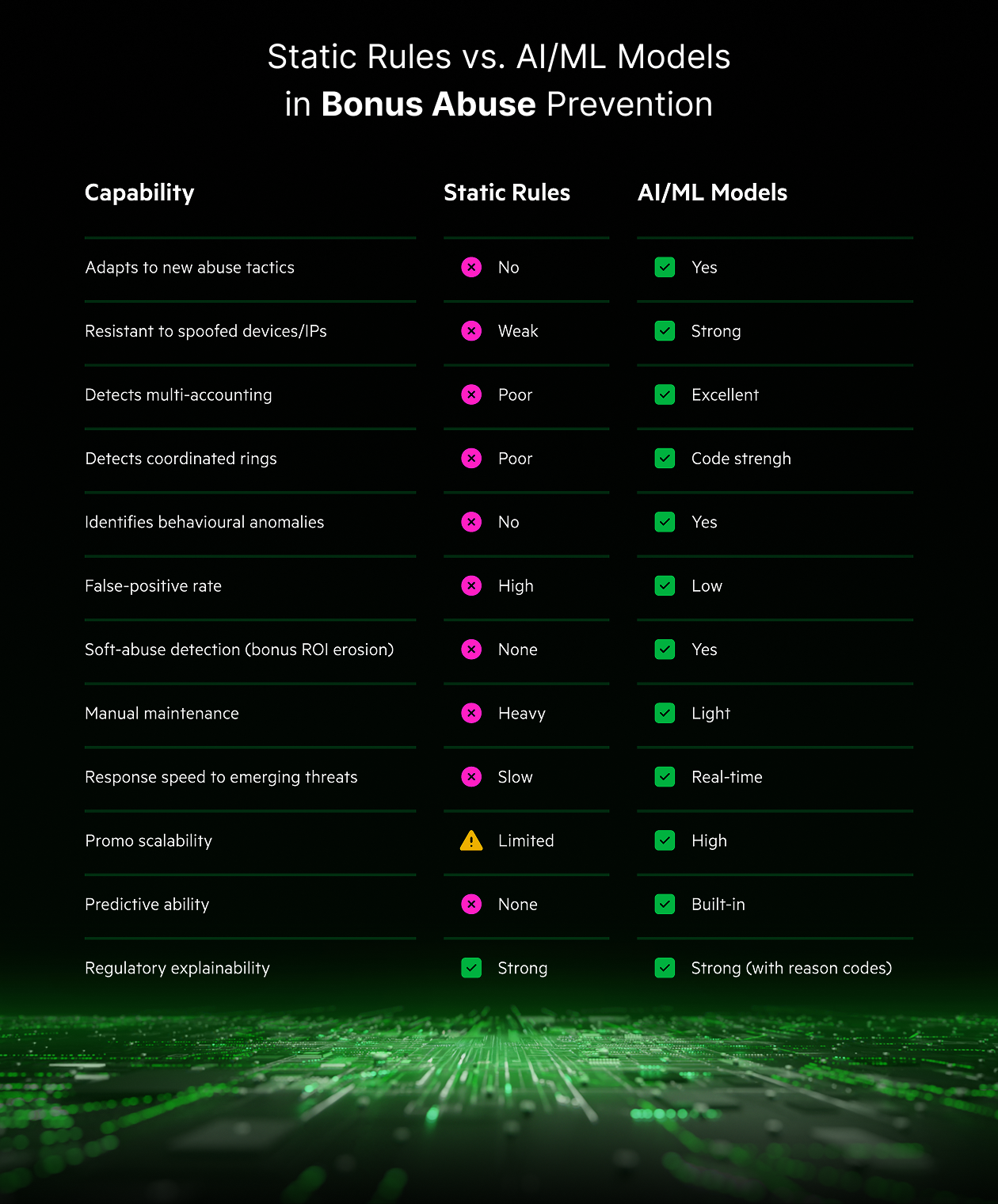
“Player profiling shifts the question from ‘does this look suspicious?’ to ‘does this action look suspicious for this specific player?’ says Pettersen. By building dynamic profiles, operators can assign risk scores that evolve as new data comes in, focusing attention where it’s needed.”
This approach enables more targeted action. Instead of blanket restrictions, operators can intervene subtly, adjusting bonus access or applying controls only where needed, without disrupting the player experience.
Counting the cost of getting it wrong
While reducing bonus abuse is essential, overcorrection can be just as costly. Aggressive checks, repeated verifications, or withdrawal delays can erode trust.
For most players, this creates friction. For VIPs, it can be the deciding factor in whether they stay or leave, making the impact far more significant for operators.
“The impact compounds the higher the value of the player,” Pettersen says. “High-value players have options, and a poor experience gives them every reason to use them. Friction at withdrawal or mid-session disrupts the very thing they came for.”
While bonus abuse is a measurable risk, losing a high-value player can have a far greater long-term impact. Controls need to be strong enough to prevent abuse, without becoming so intrusive that they damage the experience.
From detection to prevention
Operators are also pivoting their approach more broadly. Instead of focusing only on confirmed cases, there’s growing emphasis on spotting early signals, often long before abuse is proven.
“Proactive detection means looking for subtle patterns before anything has technically gone wrong,” Pettersen explains. “Prevention always costs less than recovery.”
This thinking underpins Bonus Guardian, EveryMatrix’s AI-powered bonus abuse prevention solution, built to keep operators ahead of evolving threats.
By analysing behavioral signals, such as consistent betting patterns, optimized bonus use, or coordinated activity, it identifies risk early, often before any financial impact.
This allows operators to reduce exposure without adding unnecessary friction for legitimate players.
The result is better protection of promotional spend and a more sustainable, player-centric approach to fraud prevention.
The full article is available on the iGamingBusiness website and you can access it through this link.
Ready to start a conversation?
The key for us as a true B2B iGaming software provider is to help gaming operators implement bold ideas and unleash their creativity. Everything is possible.
Talk to an expert