Bonus abuse in iGaming: the hidden costs operators ignore
Nearly 70% of all fraud in iGaming involves bonus abuse (Sumsub, 2025). Not card fraud. Not money laundering. Bonus abuse, the exploitation of free spins, deposit matches, and sign-up perks that operators put out to attract genuine players.
And it’s getting worse. Research shows promotional abuse is now the single most common type of gaming fraud globally.
Most operators know bonus abuse exists. Far fewer understand what it actually costs them or how dramatically AI fraud detection has changed what’s possible in stopping it. This article breaks down both.
The good news? AI-driven systems are changing the game entirely. By analysing vast amounts of player data, modern AI can detect and block bonus abusers before they cost you a cent, automatically, continuously, and at a scale no manual team can match. Read on to understand how the problem works and how AI stops it.
Why iGaming bonuses are a magnet for bonus fraud
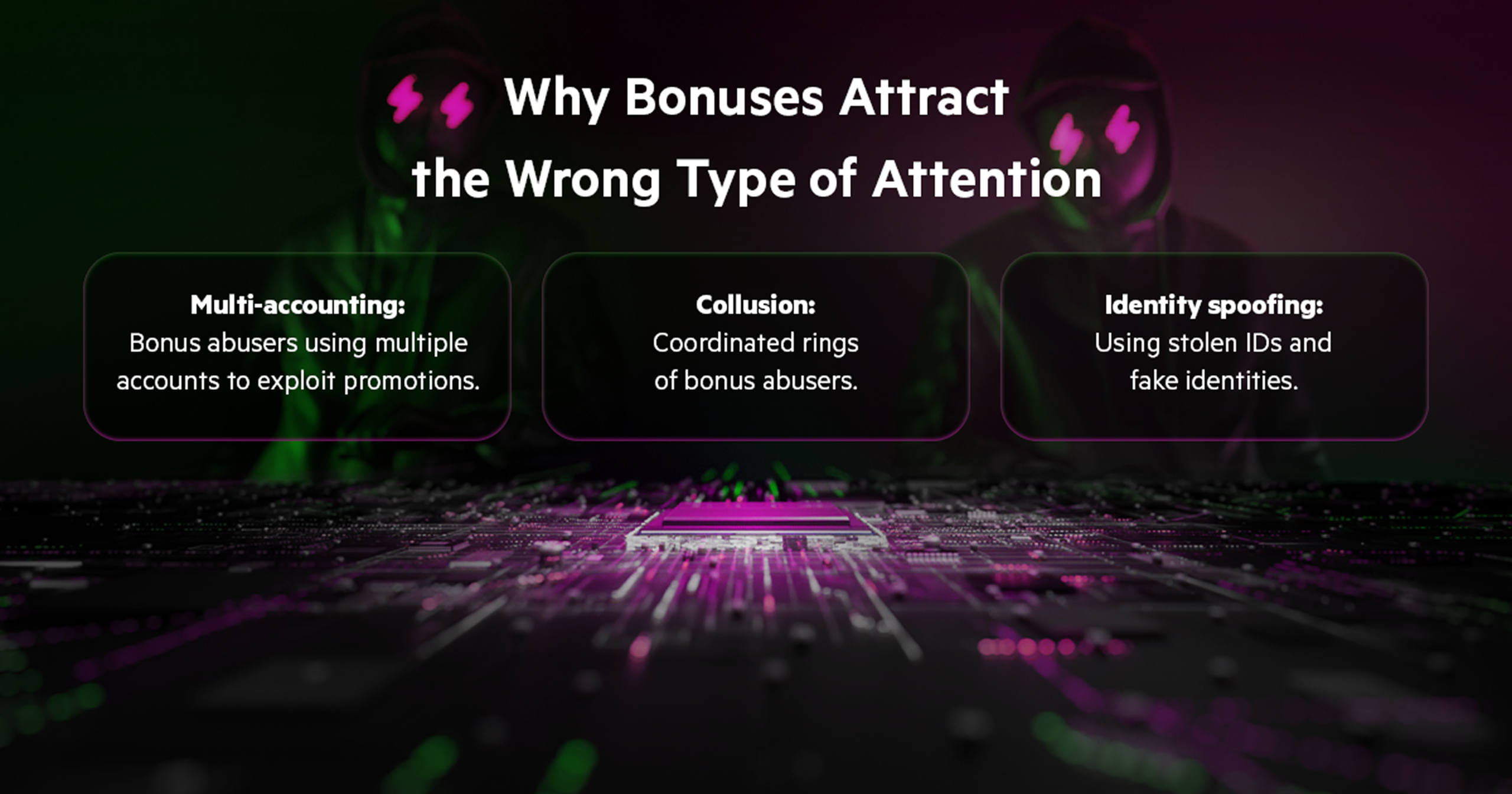
Bonuses are designed to spark excitement, but the same mechanics make them catnip for fraudsters. Known in the industry as promotional abuse or bonus hunting, this type of iGaming fraud takes several forms:
- Multi-accounting. Nobody creates just one fake account when they can spin up dozens with cheap SIM cards and VPNs.
- Identity spoofing. Stolen IDs and synthetic identities let abusers slip through weak KYC.
- Collusion. Rings of players coordinate to squeeze every last cent out of a promotion.
On a dashboard, the promo looks like a success, new accounts are up, redemption rates are high. But scratch the surface, and you may find that half your ‘new players’ vanish the moment the bonus dries up.
The hidden costs operators underestimate
Some brands pass off bonus abuse as ‘the cost of doing business’, without realising how dangerous this truly is, however the damage goes way beyond the headline number on your promo budget.
Direct financial drain
For example, you put $500,000 into bonuses. If just 10-15% is lost to abuse, that’s $50,000-$75,000 gone. This is money that could fuel real player engagement.
Multiply this across all the campaigns you’re running and it becomes an even bigger problem.
Operational drag
Fraud and compliance teams get buried in manual reviews and can spend entire weeks chasing spreadsheets of suspicious accounts, only to realise the fraudsters are already ten steps ahead.
That’s wasted time and money that could have been used to increase your revenue.
Brand trust erosion
Your genuine players will feel it as well. If promotions feel like they’re constantly being gamed, they stop trusting the system, and by extension, your brand.
That’s a long-term hit to loyalty you can’t measure in this quarter’s P&L.
Regulatory risk
Here’s what most operators don’t admit out loud: regulators hate sloppy fraud prevention. If you can’t show robust controls, you’re inviting not just abuse, but also fines and reputational damage. Regulators in mature markets (the UK Gambling Commission, Malta Gaming Authority, and state-level bodies across the US) are increasingly treating weak fraud controls as a compliance failure, not just an operational one.
That means operators who can’t demonstrate proactive bonus fraud prevention aren’t just losing promo budget, they’re accumulating regulatory exposure. That means operators who can’t demonstrate proactive bonus fraud prevention aren’t just losing promo budget, they’re accumulating regulatory exposure.
Why old defenses don’t cut it
Most operators still lean on rule-based monitoring or armies of reviewers. Both approaches used to work, but now not so much. That’s because:
- Rules are predictable. Fraudsters figure them out and simply route around them.
- Manual reviews are glacial. By the time a team spots a suspicious pattern, the bonus is already cashed out.
- Data is fragmented. Activity spread across platforms and devices makes it easy for abuse to hide in the gaps.
The result? Operators think they’re protected, but in reality, they’re running a leaky ship.
How AI fraud detection stops bonus abuse
This is where AI earns its keep and we’re not talking about it as a buzzword sprinkled into a sales deck. We’re talking real machine learning systems that crunch billions of data points operators simply can’t handle manually.
Here’s what that looks like in practice:
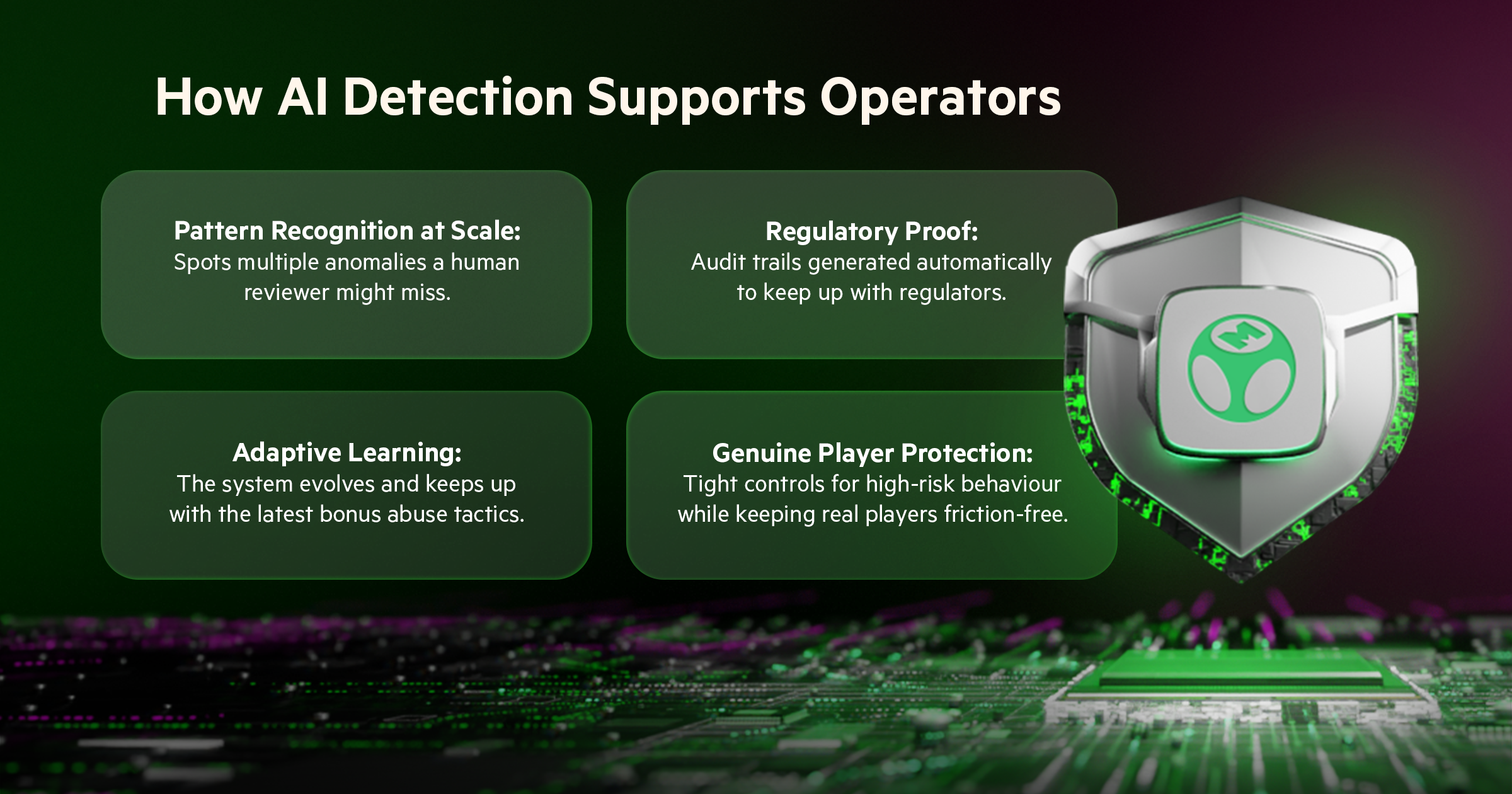
- Pattern recognition at scale: AI doesn’t just flag duplicate email addresses. It spots subtle anomalies, like 200 accounts sharing a betting pattern that screams collusion.
- Genuine player protection: Player friction doesn’t need to come as a cost to protection. AI is the layer that manages high-risk behaviour controls with the behaviour patterns of genuine players.
- Regulatory proof: AI systems automatically generate audit trails making it easier to show regulators you’re not asleep at the wheel.
To be clear, this isn’t about replacing fraud teams. It’s about giving them tools to stop playing whack-a-mole and start playing as effectively as possible.
This is how our Bonus Guardian tool works; helping to bulletproof your defense against bonus abusers, and your team prevent such cases.
Unlike traditional rule-based systems, Bonus Guardian’s AI fraud detection approach is built specifically for iGaming operators’ current needs, connecting the dots across player behaviour, device fingerprints, and betting patterns that manual reviews routinely miss.
Each of the abuse patterns described earlier (multi-accounting, identity spoofing, coordinated collusion rings) has a distinct behavioural signature. Bonus Guardian’s models are trained to detect exactly these signatures, often at the point of registration, before a single bonus is credited.
Bonus Guardian helps detect bonus abuse through:
- AI-driven analysis: Cross-referencing device data, IP addresses, registration patterns, and play behaviour simultaneously, catching multi-accounters that rule-based systems miss entirely.
- Behavioural modeling: Identifying collusion rings through shared betting patterns and coordinated withdrawal behaviour, even when accounts use separate identities and devices.
- Constant learning: Models are trained as fraud tactics evolve, so the system stays ahead of abusers who have already reverse-engineered your old rules.
The system constantly monitors player activity and the detected abusers are displayed in a widget for the operator to instantly view. After that, you can set restrictions on the detected abusers.
Bonus Guardian also constantly evolves by identifying and learning new bonus abuse patterns. As an operator you play a key role in training the model by providing verdicts such as:
- Confirmed Bonus Abuser;
- Confirmed Suspicious User;
- Not a Bonus Abuser.
Ready to stop the bonus abuse leak? Try Bonus Guardian and start saving both time and budget.
Conclusion
Remember that opening number: 70% of iGaming fraud is bonus abuse. That’s not an industry footnote. That’s the single biggest fraud vector your operation faces, and for most operators, it’s still being managed with tools built for a simpler era.
The operators pulling ahead aren’t just cutting losses. They’re redirecting the budget that was quietly funding fraudsters back into genuine player acquisition. They’re building the audit trails regulators increasingly demand. And they’re doing it without burying their compliance teams in manual reviews.
Bonus abuse is a solvable problem. The question is whether you solve it before it gets worse, or after it already has.
Ready to start a conversation?
The key for us as a true B2B iGaming software provider is to help gaming operators implement bold ideas and unleash their creativity. Everything is possible.
Talk to an expert