Bonus abuse cost: how much are iGaming operators really losing?
The bonus abuse cost most iGaming operators report is just the tip of the iceberg. Fraud teams catch the obvious cases, but reports show bonus abuse makes up 63.8% of iGaming fraud and can drain up to 15% of annual revenue. (Sumsub, 2025)
The real bonus abuse cost is hidden in the metrics executives trust most: inflated CAC, fake Lifetime Value (LTV), and loyalty metrics that look healthy but mask shrinking margins. In other words, you might already be a victim of bonus abuse without even knowing.
The hidden bonus abuse cost: 4 ways it distorts your financials
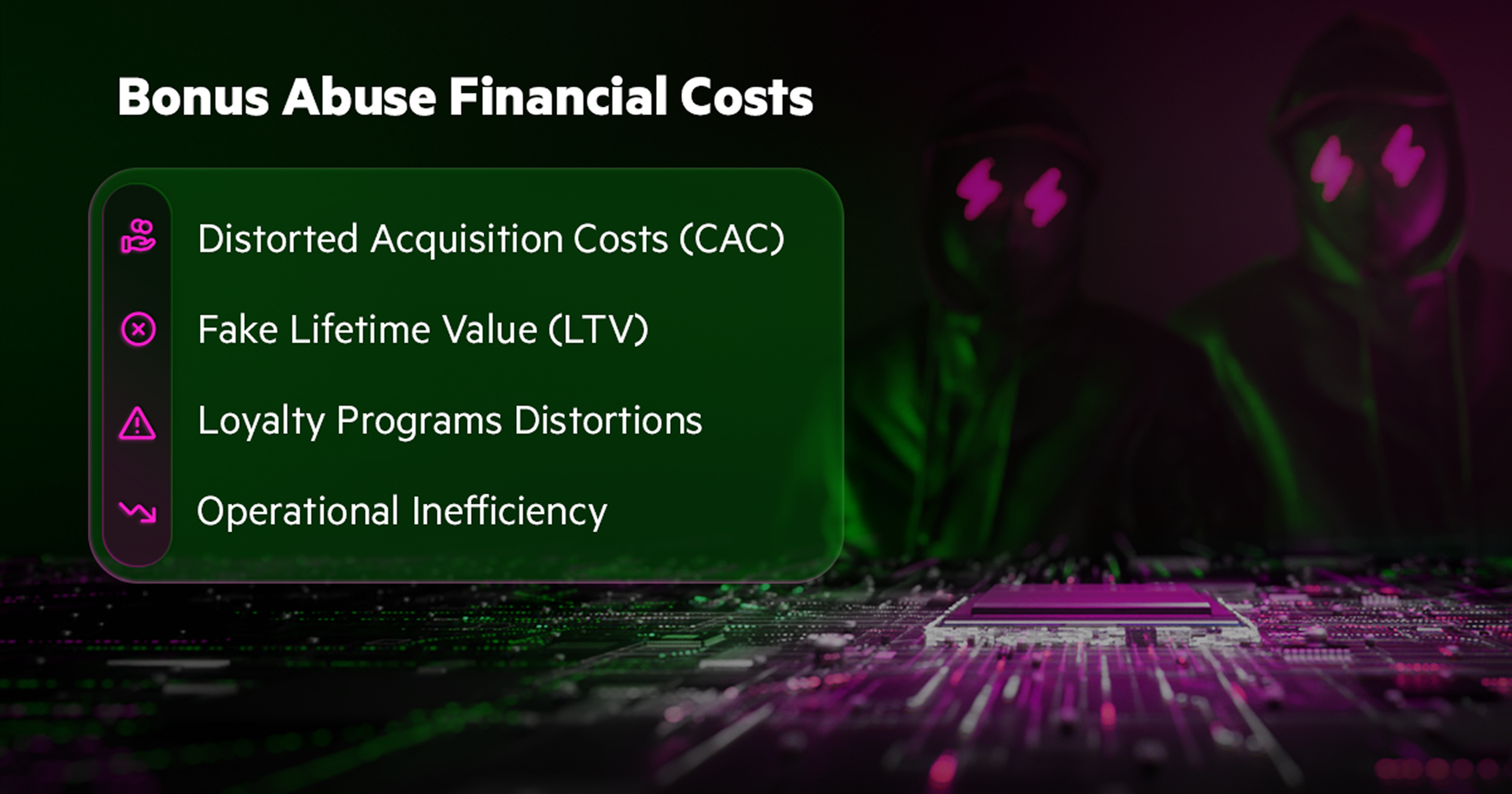
Bonus abuse doesn’t always show up as a line-item loss. The true bonus abuse cost is structural. It creeps into acquisition, retention, and ROI metrics long before anyone notices.
1. Distorted Acquisition Costs (CAC)
On paper, your CAC might look like £200 per player. But if 20% of new signups are abusers, the real CAC for genuine players jumps closer to £250.
That’s marketing budget wasted on acquiring ghosts who will never generate value. As SEON pointed out in one of their studies, bonus abuse ‘inflates CACs and poisons retention data.’
2. Fake Lifetime Value (LTV)
Fraudsters often mimic legitimate early activity, depositing, wagering, even generating small wins. In the short term, they can look like high-value players, inflating LTV models and skewing forecasts.
Marketing strategies build on this ‘phantom value’ end up overspending to chase what looks like profitability but isn’t.
3. Loyalty Programs Distortions
VIP clubs and retention schemes are prime targets. Syndicates cycle through multiple accounts to farm loyalty rewards, diluting the value of genuine player engagement.
The result: KPIs suggest loyalty initiatives are working, when in reality abusers are draining them.
4. Operational Inefficiency
Each abuse case requires manual review, documentation, and escalation. Even if caught, the resource drain raises the cost per fraud case and distracts teams from higher-value risk management tasks.
Together, these distortions create a dangerous illusion. Fraud may look under control, but in reality, operators are funnelling money into acquisition and retention strategies built on bad data.
The full business impact of bonus abuse cost
Quantifying the total bonus abuse cost requires looking beyond direct fraud losses. When CAC, LTV, and retention metrics are poisoned at the source, every strategy built on them is flawed from day one.
Misleading KPIs
Inflated acquisition numbers can make campaigns look like runaway successes.
Looking at our previous examples, an operator may report CAC at £200. But if 20% of those ‘new players’ are bonus abusers, the real CAC for genuine players is closer to £250.
That difference scales quickly, a £1m acquisition campaign could be leaking £200k straight into fraudulent accounts.
Budget Misallocation
Fraud gives the illusion that certain promotions, channels, or geographies are performing. Marketing spend is then funnelled into these areas, while genuine high-value sources are overlooked.
GBG has highlighted industry estimates that bonus abuse may cost operators up to 15% of annual gross revenue, yet much of this waste is invisible because it’s hidden inside what looks like ‘growth’.
Strategic Blind Spots
At the board level, executives rely on CAC, LTV, and retention data to make capital allocation decisions.
When these metrics are poisoned, it leads to misinformed strategy: overspending on acquisition, under-investing in player experience, or pushing into markets that appear lucrative but are riddled with abuse.
Over time, this not only risks margins but undermines shareholder confidence in leadership’s ability to allocate capital wisely.
This is why the total bonus abuse cost extends far beyond fraud losses. It undermines strategic clarity, the ability of leaders to allocate capital with confidence. And in an industry where margins are already thin, the cost of misinformed strategy can dwarf direct fraud losses themselves.
How AI accurately measures and helps reduce bonus abuse cost
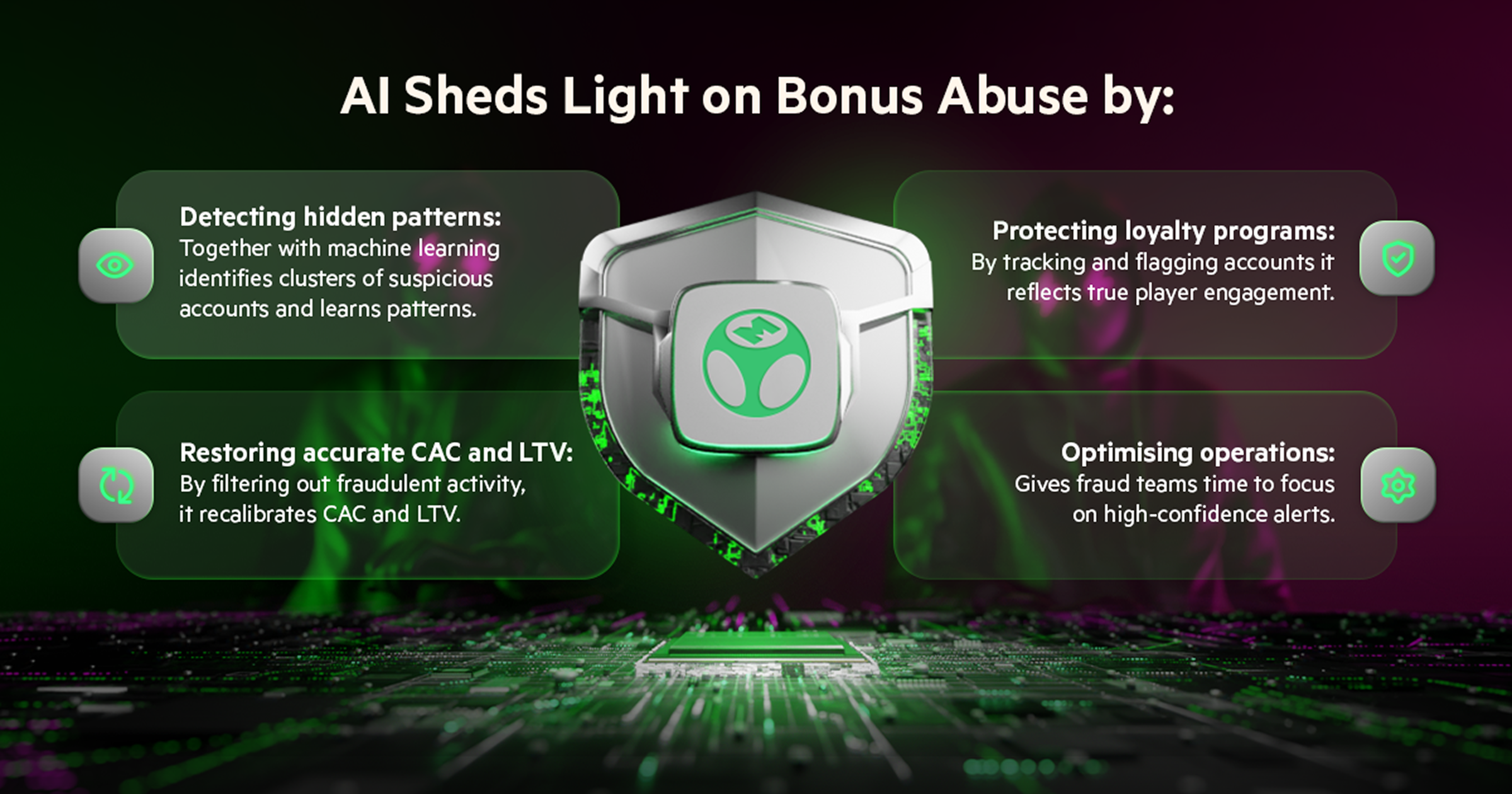
The hidden costs of bonus abuse, inflated CAC, fake LTV, distorted loyalty metrics, can seem impossible to untangle with human-only methods. AI changes that equation by revealing the true financial and operational impact.
- Detects hidden patterns: Machine learning identifies clusters of accounts that look legitimate individually but collectively indicate abuse. This allows operators to separate genuine players from fraudsters before they distort KPIs.
- Restores accurate CAC and LTV: By filtering out abuser activity, AI recalibrates acquisition cost and lifetime value metrics, giving decision-makers a realistic view of marketing ROI.
- Protects loyalty programs: AI can track and flag accounts exploiting VIP schemes, ensuring retention and loyalty metrics reflect true engagement rather than fraudulent churn.
- Optimises operations: Fraud teams can focus on high-confidence alerts rather than chasing false positives, reducing wasted time and operational costs.
Tools like Bonus Guardian are designed specifically for the iGaming sector. By continuously analysing transactional and behavioural data, it surfaces actionable insights that allow operators to quantify exactly how much they’re losing to bonus abuse, and take immediate steps to protect margins.
In short, AI doesn’t just stop losses; it restores the integrity of the data that underpins every marketing, loyalty, and investment decision.
The Strategic Imperative: Stop Flying Blind
Bonus abuse is not just a fraud problem, it’s a financial distortion problem. It quietly inflates CAC, fabricates LTV, and drains loyalty budgets, leaving decision-makers with data that misleads more than it informs. In a sector where margins are already thin, continuing to rely on skewed metrics is no longer sustainable.
Forward-looking operators are already acting. By using AI to filter abusers from genuine players, they’re reclaiming marketing ROI, protecting loyalty programmes, and restoring confidence in the numbers guiding their strategy.
The question is simple: How much are you really losing to bonus abuse?
With Bonus Guardian, you don’t have to guess. Our AI-powered platform reveals the hidden costs fraud has on your business, and helps you stop the leakage before it compounds further.
See how Bonus Guardian can uncover the true ROI picture for your operation.
Ready to start a conversation?
The key for us as a true B2B iGaming software provider is to help gaming operators implement bold ideas and unleash their creativity. Everything is possible.
Talk to an expert