AI bonus abuse detection: Why rule-based systems are losing and what beats them

Bonus abuse is costing iGaming operators billions, and the tools most of them use to stop it are losing ground fast. Fraudsters run syndicates, clone identities, mimic legitimate players, and probe for rule gaps around the clock.
For every patch an operator applies, two new schemes appear. The result is an arms race where static, rule-based defences are always behind.
This article breaks down why rule-based systems are structurally unfit to win that battle, and why AI bonus abuse detection is the only credible alternative.
Why bonus abusers keep winning against rule-based systems
Fraudsters don’t move in straight lines, they adapt, iterate, and exploit every gap that rules leave open. As rule-based systems lag, the bonus abuser’s toolkit expands. Here’s how they gain the upper hand:
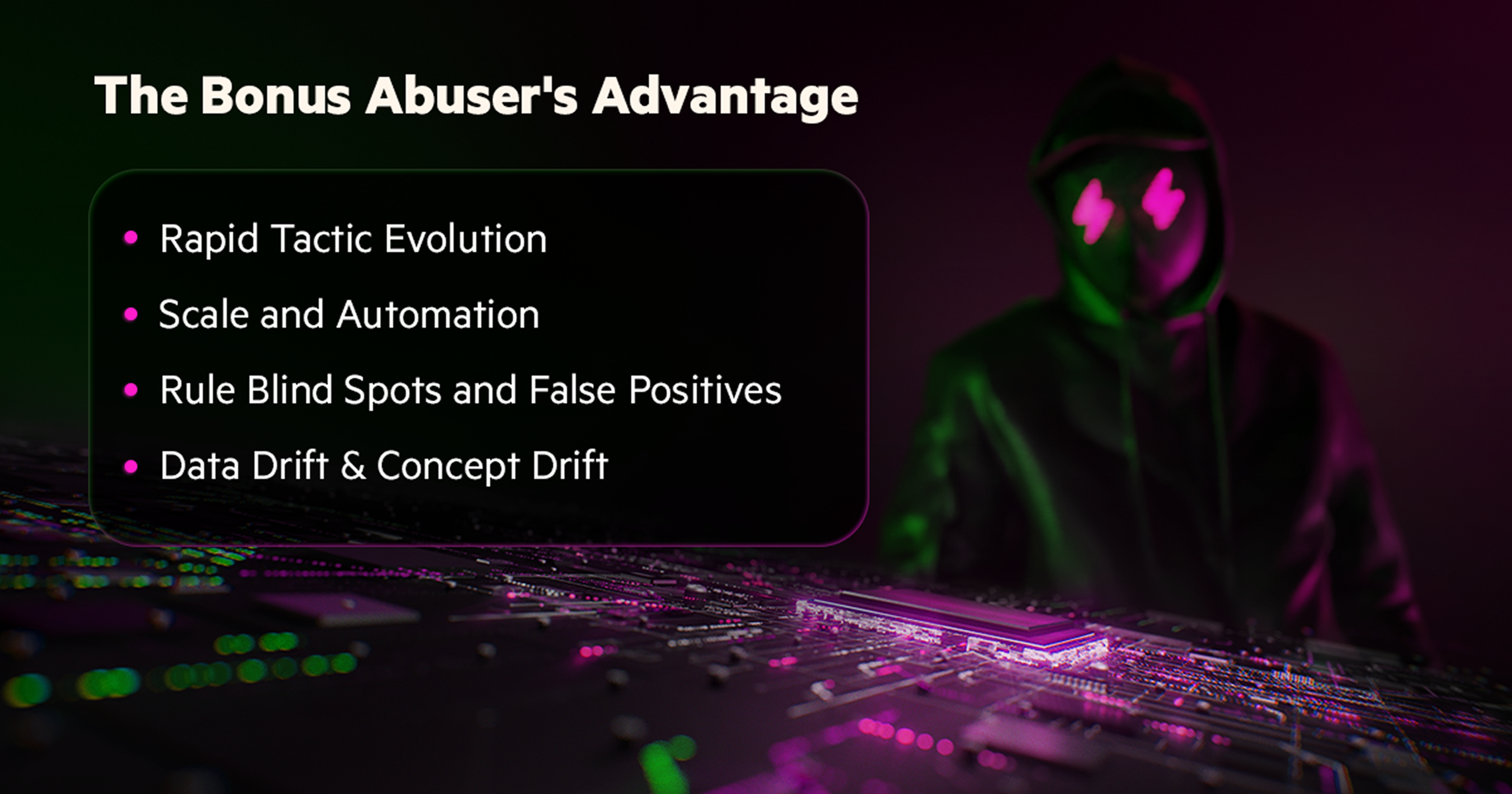
Rapid Tactic Evolution
Bonus abuse, multi-accounting, device spoofing, and behavioural mimicry are constantly mutating. Bonus abuse tactics are evolving fast. Fraudsters monitor rule updates and adjust in near real time, exploiting gaps faster than operators can patch them. Between 2022 and 2024, iGaming fraud surged nearly 64% year-over-year. (Sumsub, 2024).
Scale & Automation
Fraud has become industrial. Bots, virtual machines, and coordinated networks act across regions simultaneously. In 2023, mobile casinos and betting platforms lost $1.2 billion to sophisticated fraud schemes.
A single automated system can simulate dozens of player sessions per hour, mimicking deposit, wagering, and withdrawal behaviour, then move to another operator once flagged. Human teams and static rules can’t keep up with this volume and speed.
Rule Blind Spots and False Positives
Static rules generate false positives, frustrating genuine players, and leaving subtler abuse undetected. According to Sumsub’s iGaming Fraud Report, 83% of operators reported an increase in fraud in the past year.
Data Drift & Concept Drift
Fraud isn’t static. Player behaviour, device usage, and bonus structures constantly evolve. Rules written last year can’t catch today’s schemes. Machine learning models, by contrast, continuously self-adapt, identifying hidden links across accounts, geographies, devices, and transaction patterns.
AI can recognise that several accounts with low individual activity are all connected via device fingerprints, IP clusters, or timing patterns, flagging them even when each account looks normal on its own.
The rulebook is broken

Operators aren’t losing because they don’t care, they’re losing because the tools they rely on were never built for an arms race. Rule-based systems were designed for yesterday’s fraud, not today’s industrialised schemes.
- Reactive by Design: Rules only catch what’s already happened. They’re historical patches, not proactive defences.
- Maintenance Hell: Dozens or even hundreds of overlapping rules become a drag on teams, creating complexity, blind spots, and operational fatigue.
- Collateral Damage: Rules frustrate legitimate VIPs while fraudsters learn how to stay just under the thresholds. False positives rise, revenue leaks, and trust in the system erodes.
- False Sense of Security: Rule-heavy setups create dashboards full of alerts, but they don’t stop the underlying abuse. Fraud is still growing, and faster than rules can be written.
The harsh truth: Rule-based defences aren’t just underperforming, they’re actively misleading operators into thinking fraud is under control when the reality is billions lost and margins eroded.
Humans are outmatched
Fraud teams today face an almost impossible task. A single, mid-sized operator may see hundreds of thousands of bonus claims each month, many of them perfectly legitimate. Within that flood of data, abusers deliberately disguise themselves, spreading activity across multiple accounts, devices, and timeframes. The signals are faint, and by the time a manual review flags something suspicious, the damage is often already done.
The problem isn’t that fraud teams lack expertise, it’s that they’re fighting an industrialised enemy with human limits. Syndicates run operations with automated scripts and even their own machine learning tools, probing for weak spots around the clock. By contrast, review teams spend their days firefighting alerts, overloaded with cases, fatigued, and prone to error.
Even the best-trained professional can’t compete with adversaries who operate at machine speed. Human-only defence will always be a step behind, and in the economics of bonus abuse, being late by even a few hours can mean tens of thousands lost.
How AI bonus abuse detection actually works
AI doesn’t just process more data than humans, it thinks differently. Instead of relying on static rules that fraudsters can predict and sidestep, machine learning models adapt as behaviour evolves. They spot patterns no human could reasonably hold in mind: the subtle timing between logins across accounts, the micro-differences in betting behaviour, or the networked connections hidden behind different IPs and devices.
Crucially, AI systems grow stronger the more data they ingest. Where manual reviews grind to a halt under volume, AI scales effortlessly, transforming oceans of raw player activity into a living model of risk that continuously refines itself. For operators, this means faster detection, fewer false positives, and a level of consistency that humans simply cannot deliver.
And unlike black-box algorithms that ask for blind trust, explainable AI provides transparency: highlighting why a decision was made, and giving risk teams the confidence to act decisively. In the bonus abuse arms race, this combination of speed, adaptability, and clarity is why AI doesn’t just compete with fraudsters, it outpaces them.
Stop chasing bonus abusers. Start outpacing them.
Bonus abuse isn’t a passing nuisance, it’s a permanent, evolving threat that drains margins and destabilises business models. Operators who continue to rely on human reviews and static rules are essentially playing defence with outdated tools, while fraudsters invest in automation and coordination.
The operators who will win are those who embrace AI not just as an add-on, but as the core of their fraud strategy. With systems like Bonus Guardian, every new data point sharpens detection, every attempted exploit strengthens the model, and every decision comes with the clarity risk teams need to act fast.
In an industry where bonuses drive acquisition and loyalty, failing to protect them means failing to protect growth. The arms race is already here. The only question is whether your operation will keep chasing fraudsters, or finally move faster than them.
Ready to start a conversation?
The key for us as a true B2B iGaming software provider is to help gaming operators implement bold ideas and unleash their creativity. Everything is possible.
Talk to an expert